

Diamond Quality Criteria: The 4 Cs, simply explained
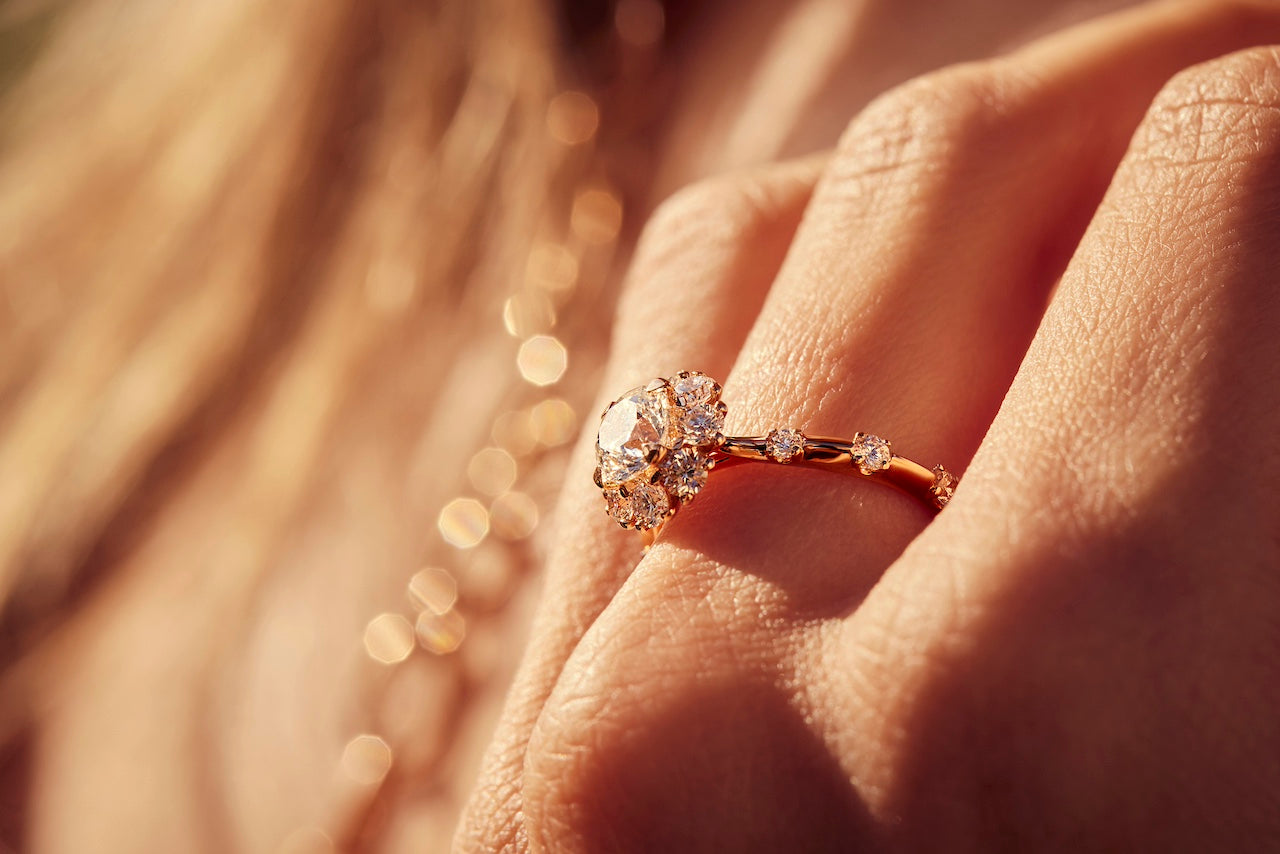
Do you remember the last time you noticed the sparkle of a diamond on someone's finger or wrist?
A diamond doesn't achieve that radiance by chance. It's the precise interplay of light, proportion, and internal clarity that makes it appear alive.
What seems effortless follows clear diamond quality criteria, the so-called 4Cs.
In this article, you will learn how the 4Cs work together and what truly matters when selecting a high-quality diamond.
The 4 Cs of Diamonds: Fundamentals of Quality Assessment
The so-called 4Cs form the basis of every diamond assessment. They describe four key characteristics that determine a stone's brilliance, quality, and value: Carat (weight), Clarity (purity), Cut (shape), and Colour (color).
This system was developed by the Gemological Institute of America and is now recognized worldwide as the binding standard for evaluating diamonds.
Carat, Clarity, Cut, and Colour at a Glance
The 4 Cs each look at a different aspect of the stone:
- Carat describes the weight of the diamond
- Clarity evaluates internal characteristics such as inclusions
- Cut determines how light is reflected within the stone
- Colour indicates how colorless a diamond appears
Only when these four criteria interact does a complete picture emerge. No single value alone determines the quality of a diamond.
Why the 4 Cs Determine a Diamond's Impact
A diamond's impact is primarily created by light. How this light is absorbed, refracted, and reflected depends directly on the 4Cs.
The cut plays a particularly central role: It determines whether the light inside the stone is bundled and reflected back or escapes unused. A precisely cut diamond therefore appears livelier and more brilliant.
Clarity also influences perception. Inclusions can scatter light or slightly reduce the stone's clarity, even if many are not visible to the naked eye.
The color has a subtle but decisive effect: The more colorless a diamond appears, the clearer and more radiant its overall appearance.
And finally, the weight – or carat – not only determines the size but also the presence of a stone. At the same time, more weight does not automatically mean more brilliance, as this depends heavily on the cut.
Thus, it becomes clear: A diamond's impact is not created by a single factor, but by the interplay of all characteristics.
How the Quality Criteria Work Together
You should never view the 4Cs in isolation. A diamond is convincing when its characteristics are in balance:
- For example, a well-proportioned cut can visually compensate for smaller inclusions and create a strong presence even with a lower carat weight.
- Conversely, a large stone without a precise cut can lose its radiance.
Clarity and color also influence each other in their effect: A very clear diamond allows light to pass through the material unimpeded, making its color effect appear calmer and more homogeneous.
A consciously chosen diamond combines:
- balanced proportions
- clear light guidance
- a calm, natural radiance
This creates a piece of jewelry that convinces not only by individual values, but by its overall effect, and that is precisely where its true quality lies.

Diamond Quality in Focus at Herzog Loibner
At Herzog Loibner, we view every diamond as part of a larger whole. Selection, proportion, and setting follow a clear line: calm, balanced, and designed for long-term quality.
We select stones not based on individual top values, but on their interplay: A diamond should not only appear brilliant, but harmonious.
In our goldsmith's workshop, we combine this approach with precise craftsmanship and a fine sense of proportion. This creates jewelry that is naturally worn and whose quality is not loudly displayed, but felt in its effect.
If you would like to discover this form of understated precision and timeless design, you will find diamond jewelry in our selection that showcases precisely this interplay of quality and expression:
Clarity: Structure, Inclusions, and Evaluation
A diamond's clarity describes its internal structure. It shows the extent to which natural features are present in the stone, which arose during its formation.
These so-called inclusions are present in almost every diamond. What matters is not their existence, but their visibility and position.
For evaluation, experts examine the stone under 10x magnification. They pay attention to the size, number, and location of the inclusions and classify the diamond accordingly.
Inclusions and Their Effect on Brilliance and Appearance
Inclusions primarily affect a diamond's light effect. The clearer the structure, the calmer and more even the play of light appears.
Larger or unfavorably placed inclusions can scatter light and slightly reduce brilliance. At the same time, many of these features remain invisible in everyday life.
Typical inclusions include:
- fine crystals
- small cracks ("Feathers")
- pinpoint structures ("Pinpoints")
In most cases, they do not affect the durability or everyday wearability of your jewelry.
The Clarity Scale from Flawless to SI
Clarity is evaluated using an internationally standardized scale:
- FL / IF: no or virtually no internal characteristics
- VVS: very, very small inclusions that are barely discernible
- VS: small inclusions visible under magnification
- SI: inclusions partially discernible, but usually not with the naked eye
Many diamonds fall within the VS to SI range. This often creates a balanced combination of clarity, natural structure, and price.
A diamond does not have to be completely flawless to appear clear and high-quality. What matters is how calm and harmonious the overall impression appears.
Carat: Size, Weight, and Value in Balance
Carat describes a diamond's weight, not its visible size. One metric carat is equivalent to 0.2 grams and is divided into 100 points. This allows for very precise weight specification, such as 0.75 ct or 1.00 ct.
This distinction is important for selection: two diamonds can have the same carat weight and still appear differently sized. Carat thus provides a measurable value but does not yet say anything about how present a stone actually appears on a finger or in a pendant.
Size and Brilliance in Harmony
A higher carat weight does not automatically mean that a diamond appears larger or more impressive. The GIA explicitly states that a poorly proportioned stone can "hide" weight, for example in its depth, girdle, or pavilion. While it may weigh more, it doesn't show a correspondingly larger surface from above.
Precisely for this reason, you should never consider carat in isolation. The cut also plays a role in how large, lively, and brilliant a diamond appears.
A precisely cut stone utilizes light better, often appears more balanced, and can visually be more convincing than a heavier diamond with a weaker cut.
The shape also influences the impression of size. Elongated fancy shapes like oval, marquise, or pear often appear larger than a round brilliant of the same carat weight.
If visible presence is important to you, it is always worthwhile to consider proportion, cut, and shape simultaneously.
How Carat Influences Price
Carat is one of the most important price factors for a diamond.
Larger stones are rarer than smaller ones, so not only does the overall price increase, but usually also the price per carat: A 1-carat diamond, with the same quality characteristics, is worth significantly more than four diamonds each weighing 0.25 carats.
For your selection, this means: More carat increases the value, but not automatically the beauty. It is better to focus on the balance of the 4 C's so that your piece of jewelry truly shines.
Cut: Precision and Light Performance
The cut is the factor that visibly shapes brightness, fire, and scintillation. These are precisely the light reflections that make a diamond appear lively and brilliant.
For you, one thing is particularly important: A diamond can be high quality in color and clarity and still appear less impressive if the cut does not guide light precisely. Conversely, a well-cut stone can unfold significantly more presence because its proportions utilize light better.
Precisely for this reason, you should never understand the cut as merely a technical specification, but as the basis of the entire radiance.
The Brilliant Cut and its Proportions
The classic round brilliant is considered the cut that is most strongly designed for light effect. A so-called Round Brilliant has 57 or 58 facets that are specifically arranged to bring brightness, fire, and sparkle into a balanced relationship.
Its effect is not created by a single surface, but by the interplay of all proportions.
Crucial factors include:
- Table size
- Crown angle
- Pavilion angle
- Girdle
- Symmetry
Recognizing and Classifying Cut Quality
For round brilliants, there are five cut grades: Excellent, Very Good, Good, Fair, and Poor. This classification helps you better assess the quality of the light performance.
An Excellent Cut typically shows high brightness, clear contrasts, and balanced sparkle. As cut quality decreases, the light appears less precise. The diamond appears flatter and loses its liveliness.
When evaluating a diamond, pay particular attention to the overall impression:
- Does the stone appear lively?
- Does it reflect light evenly?
- Does it create a calm, harmonious light pattern?
A certificate can also provide guidance, as it documents the cut quality in a verifiable way. However, it is important to note: Official cut evaluations only apply to round brilliants. For other shapes, your own impression of the light effect is more decisive.
Holistic Understanding of Quality: Selection and Standards
In this section, you will learn how to set priorities meaningfully, evaluate origin correctly, and read certificates specifically to make an informed and coherent decision.
Prioritizing the 4 Cs Correctly
When choosing a diamond, you should consciously prioritize the 4Cs, as not all criteria need to be at the highest level.
For a balanced and value-stable selection, the following guidelines are recommended:
- Focus on the cut: Choose "Excellent" or "Very Good" if possible. The cut determines whether your diamond appears lively or flat.
- Choose clarity with discretion: VS1, VS2, or SI1 often offer a clear appearance without visible inclusions. Higher clarity grades often do not bring additional optical benefits but significantly increase the price.
- Stay in the upper mid-range for color: Color grades between G and H usually appear colorless and harmonious – especially in yellow or rose gold settings.
- Use carat strategically: Choose weights just below "magic limits" (e.g., 0.9 ct instead of 1.0 ct). This way, you achieve a similar size at a noticeably better price-performance ratio.
This combination ensures that your diamond appears calm, clear, and high-quality.
Natural vs. Synthetic Diamonds Compared
Natural and synthetic diamonds are made of the same material and often appear identical at first glance. The difference lies in their origin.
- Natural diamonds form over millions of years in the earth.
- Synthetic diamonds are produced in a laboratory within a few weeks.
For you, this means: Both variants show similar optical properties and are evaluated according to the same 4Cs.
Transparency is particularly important. A synthetic diamond is not a substitute stone, but a real diamond with a different origin. This should always be clearly labeled.
How to Read Certificates Like GIA and HRD Correctly
A certificate provides not only values but also a structured analysis of the diamond.
Pay particular attention to these areas in the document:
- The Overview (4C at a glance): Here you will find Carat, Colour, Clarity, and Cut bundled together. Use this section for a quick comparison of several stones.
- The Clarity Map (inclusion diagram): This sketch shows where inclusions are located in the diamond. If they are closer to the edge, they often appear less disruptive than centrally placed features.
- The Proportions: Values such as table size, depth, and angles provide clues as to how well the diamond reflects light. These figures help you better estimate the brilliance.
- Polish and Symmetry: These specifications indicate how precisely the stone has been processed. Ideally, both are in the "Excellent" or "Very Good" range.
- Fluorescence: Slight fluorescence ("Faint") usually has no negative effect. Strong fluorescence, however, can make the stone appear milky.
Additionally, GIA and HRD certificates contain a unique identification number, which is often laser-engraved on the diamond itself. This allows you to securely match the stone and certificate.
Important: Do not read a certificate merely as a list of values. Use it to better understand a diamond's structure, craftsmanship, and special characteristics, and to build your decision consciously upon it.
Frequently Asked Questions
Below you will find answers to further questions on the topic that have not yet been answered in this article.
How does a diamond's carat size affect price and sparkle?
Carat describes a diamond's weight and thus influences both its size and value. As weight increases, the price generally also rises, as larger stones are rarer.
However, for a diamond's effect, carat alone is not decisive. The sparkle primarily comes from the cut. A precisely cut brilliant reflects light clearly and evenly, making it appear lively and brilliant.
Therefore, it is always worthwhile to consider carat in conjunction with other quality characteristics. A slightly smaller diamond with a very good cut can be visually more convincing than a larger stone with less precise workmanship.
What diamond quality criteria and standards for quality assessment are there?
The evaluation of a diamond is based worldwide on the so-called 4Cs: Carat, Cut, Colour, and Clarity. These four criteria enable a verifiable and comparable classification of quality.
They describe:
- Carat the weight
- Cut the light performance and brilliance
- Colour the color effect
- Clarity the internal structure
In addition, experts also consider a stone's proportions, symmetry, and finish. The decisive factor is not a single value, but the interplay of all characteristics.
A diamond appears particularly high-quality when these criteria are in balance and a calm, harmonious overall impression is created.
What should you look for when buying a piece of jewelry with diamonds, including lab-grown diamonds?
When buying a piece of jewelry, you should pay attention to the origin (natural rough diamonds versus lab-grown diamonds) as well as to certificates and test reports that confirm the internationally recognized standards for diamond quality assessment.
Check clarity grades (e.g., whether inclusions are difficult to see or easy to see), the type of cut, the diamond shape, and whether the stone is a fancy diamond.
Ask the jeweler for details on inclusions, the diamond's size, and the grading; this information will help you choose your diamond and ensure that the diamond jewelry piece reflects, sparkles, and shows the desired brilliance.